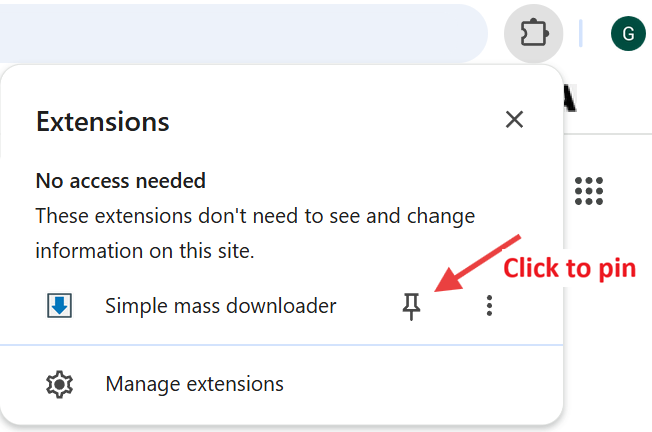
Simple Mass Downloader uses a popup as its main interface. For quick access, pin the extension to the Chrome toolbar. For this, you must first locate the general chrome extensions button in the toolbar and follow Now you can open the popup at any time by clicking its toolbar icon

Quick Start Tutorial

Simple Mass Downloader is especially useful when mass downloading requires careful identification of resources on a web page, using appropriate filtering, as well as suitable file names and destination folders.

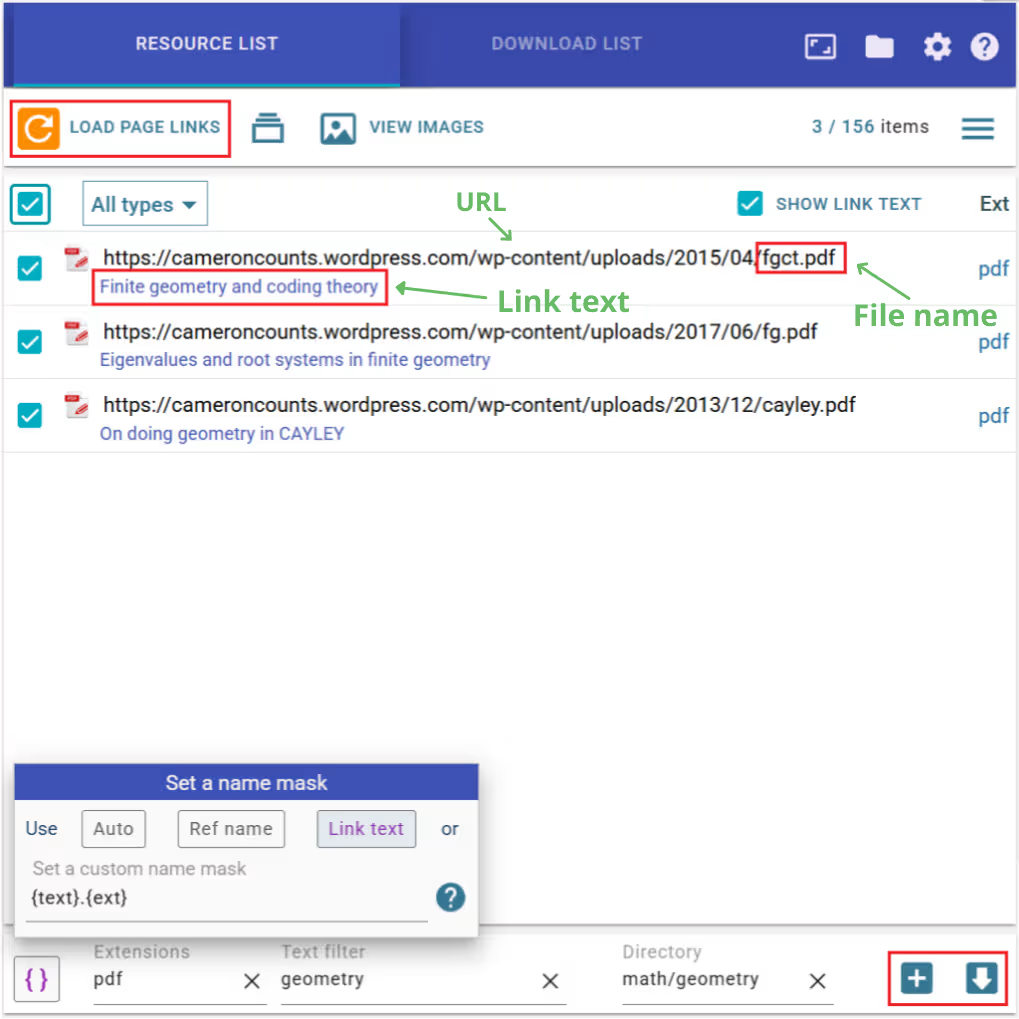
Unlike an external download manager, SMD can use contextual information from . These attributes can be used for both filtering and constructing suitable names for downloaded files or destination folders, through

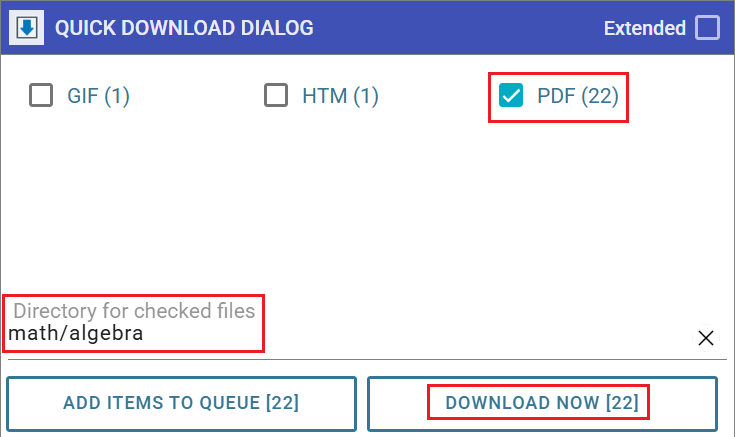
Note that destination folders are relative to Chrome’s main Downloads folder. For security reasons, Chrome extensions cannot choose an arbitrary folder path for mass downloads. For example, math/algebra means Downloads/math/algebra.

There are two main workflows: the basic and popup workflow

The basic workflow

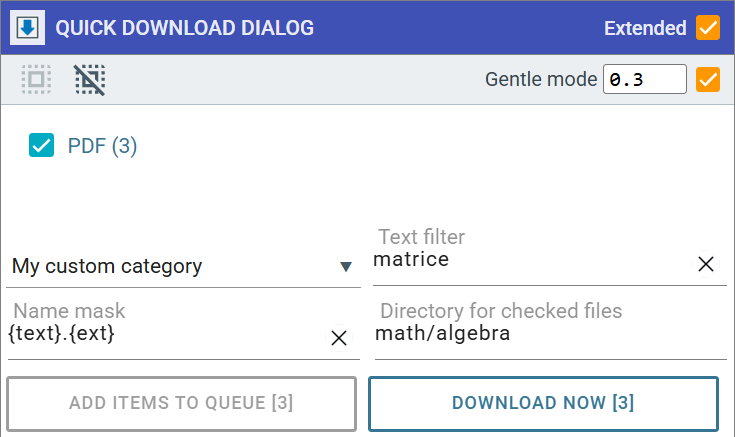
The simpler workflow uses a mini dialog opened by the standard context menu on the web page. You can use it for

  • the whole page
  • an individual link or image
  • a selected range of text containing links

Here you check the desired file types, set optionally a destination folder and finally click the Download now button

Note that there is an of this Quick download dialog with more options (filtering, name masking etc.)
The main popup workflow

The more flexible workflow uses the extension popup (click in the browser toolbar to open it).
It has two main panels: Resource list (with a list view and a thumbnails view) and Download list.

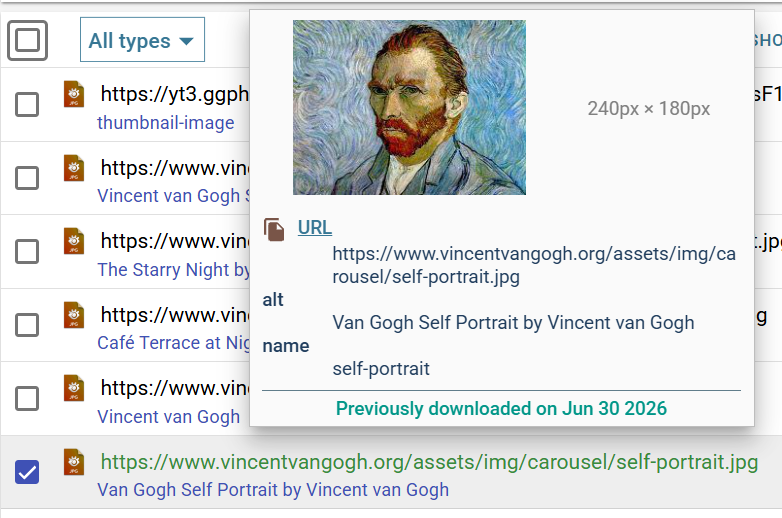
The main advantage over the Quick Download Dialog is that each item’s associated information is visible. A full is available with right-click in the Resource List, or Ctrl+right-click in the Download List.

The typical workflow involves only three steps:
  1. Click the button to load all the links/resources from the current tab
  2. Select/check from the generated resources list the desired ones
  3. Click to download them immediately or to add them to the delayed download queue

The resource list

Sometimes the minimal workflow above is not enough. Most often, you need to filter the detected resources first, in order to isolate exactly the items you want. Filtering can be done by:
  • (using default and )

Other optional but useful steps:

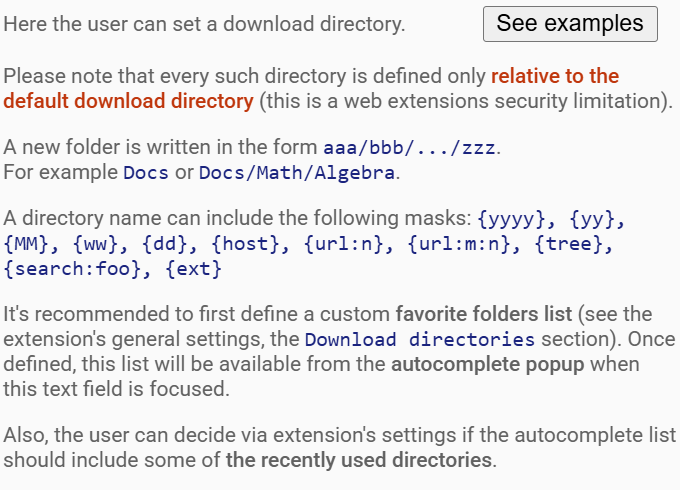
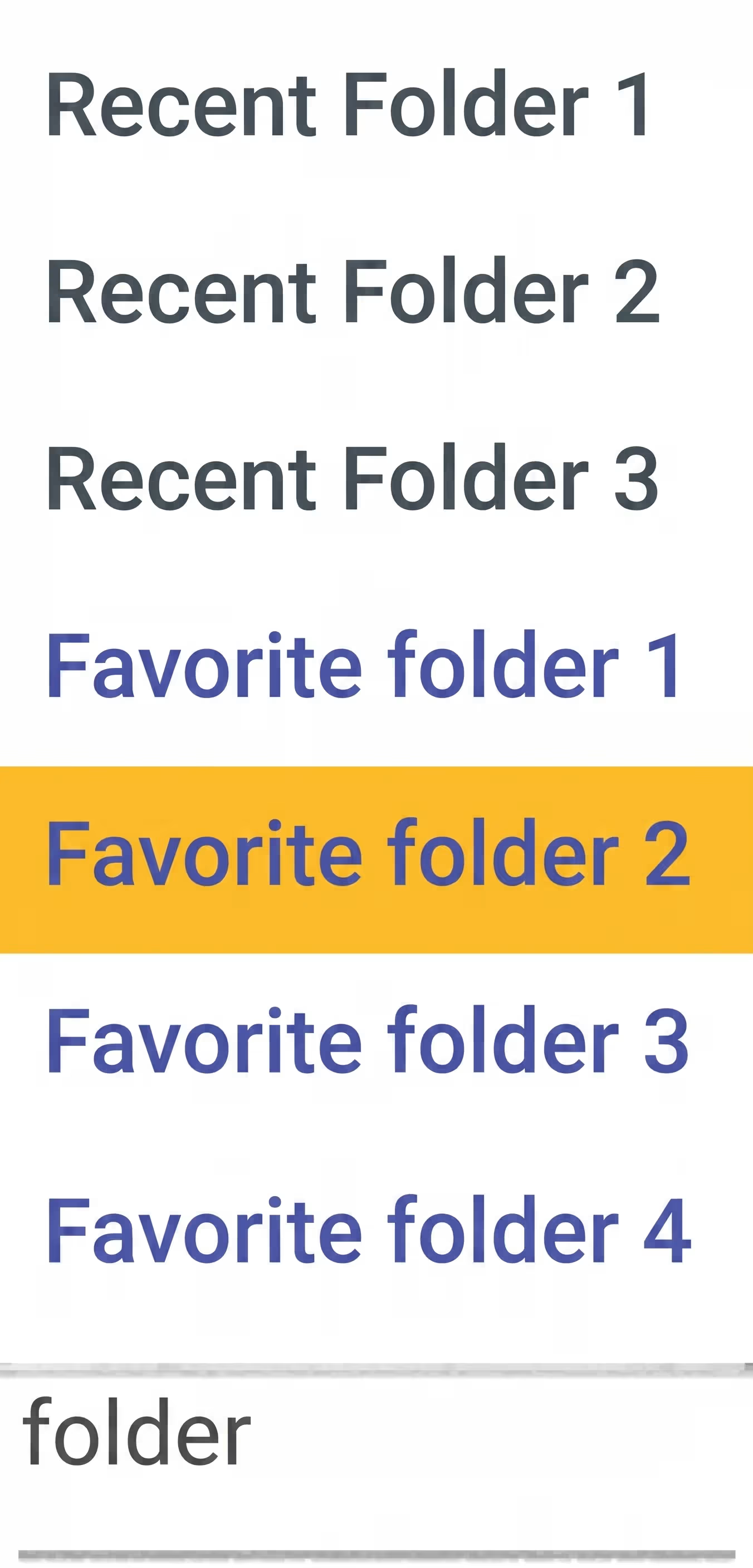
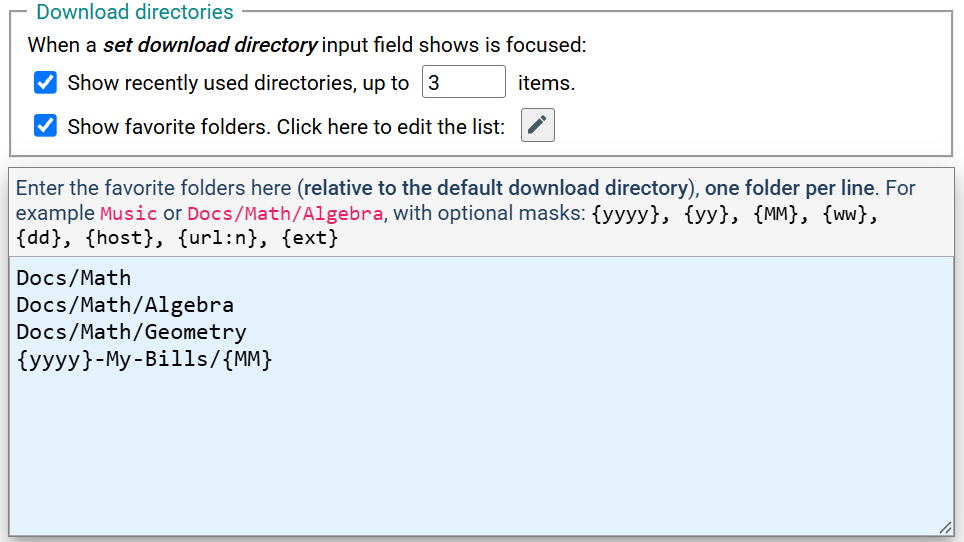
  1. Set a . The directory field has an with recently used folders and, optionally, user-defined .
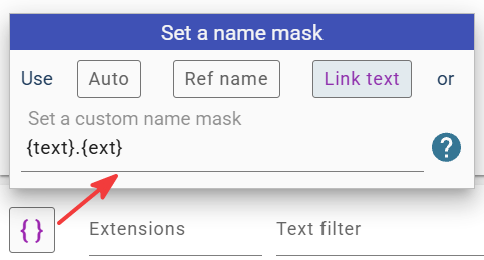
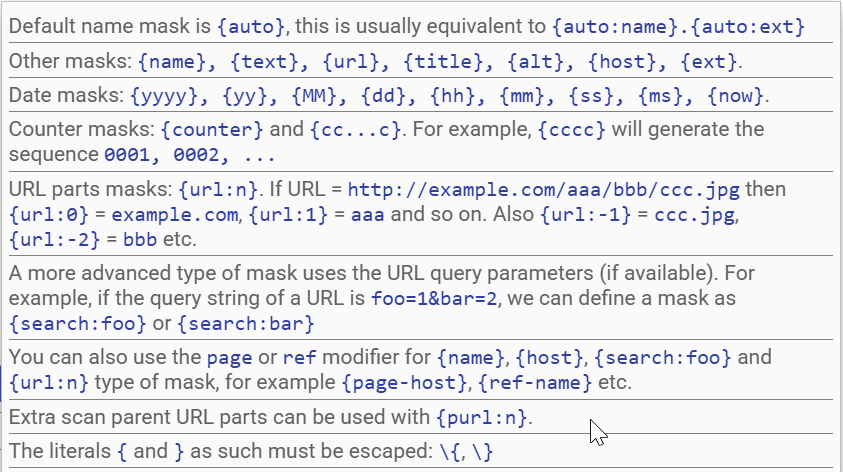
  2. Set a for all selected/checked files. In the example on the left, the name mask {text}.{ext} is preferred because it creates more descriptive names. For example, the first item becomes Finite geometry and coding theory.pdf, while the default {auto}, usually equivalent to {name}.{ext}, would produce fgct.pdf.

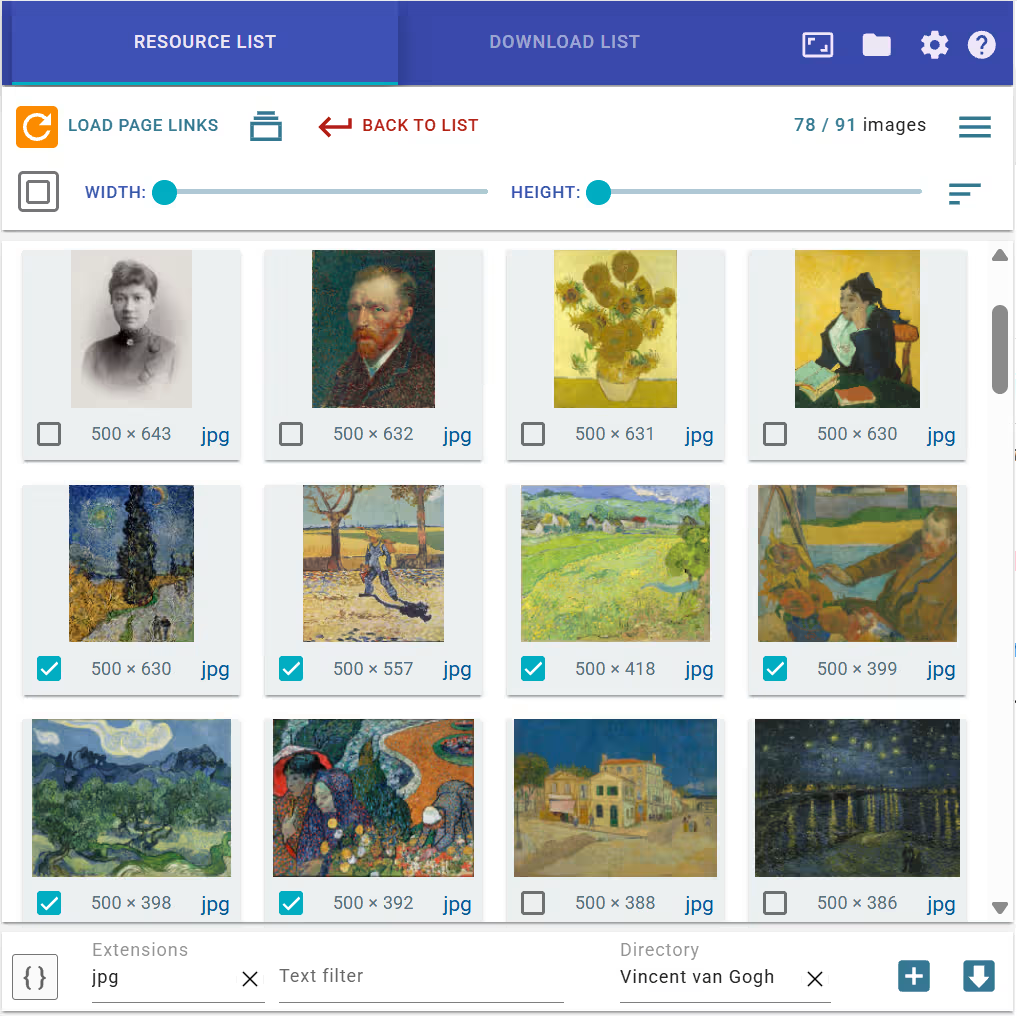
Besides the list view shown above, there is also a for images, with specific width/height filters and a button to sort by descending size.

The download list

As noted earlier, items can be sent to the Download List either with to start downloading immediately, or with to add them to the delayed download queue.

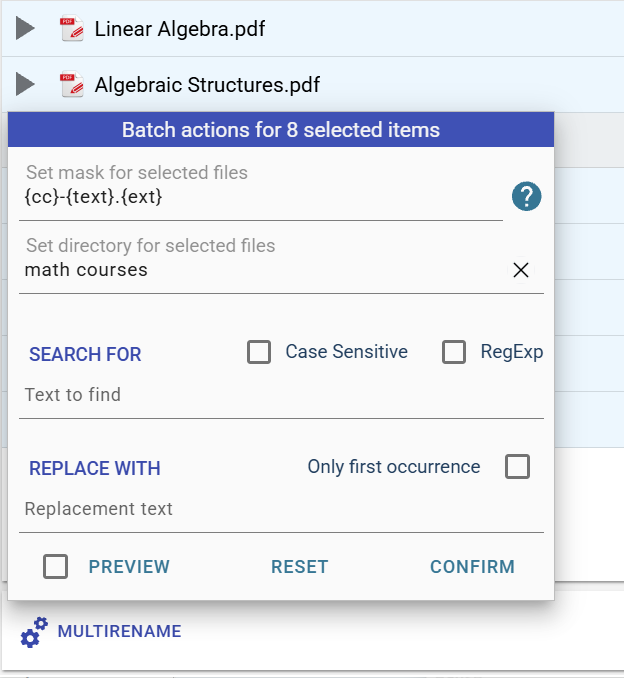
The first option is usually preferred, but the delayed queue is useful when you need to refine items at the Download List level before starting them. There you can use the for more advanced batch actions, including name masks, search-and-replace rules, and preview changes. Unstarted items can also be reordered with Ctrl + Up/Down, which is especially useful when using counter masks.

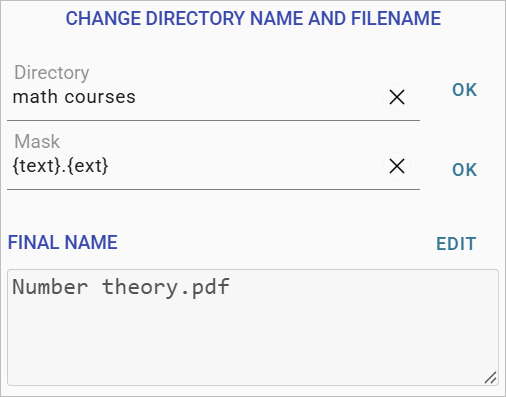
You can also make finer adjustments for individual items using the .

The Download List also provides the usual download management actions: start items individually or in groups, pause, resume, cancel, or remove them.
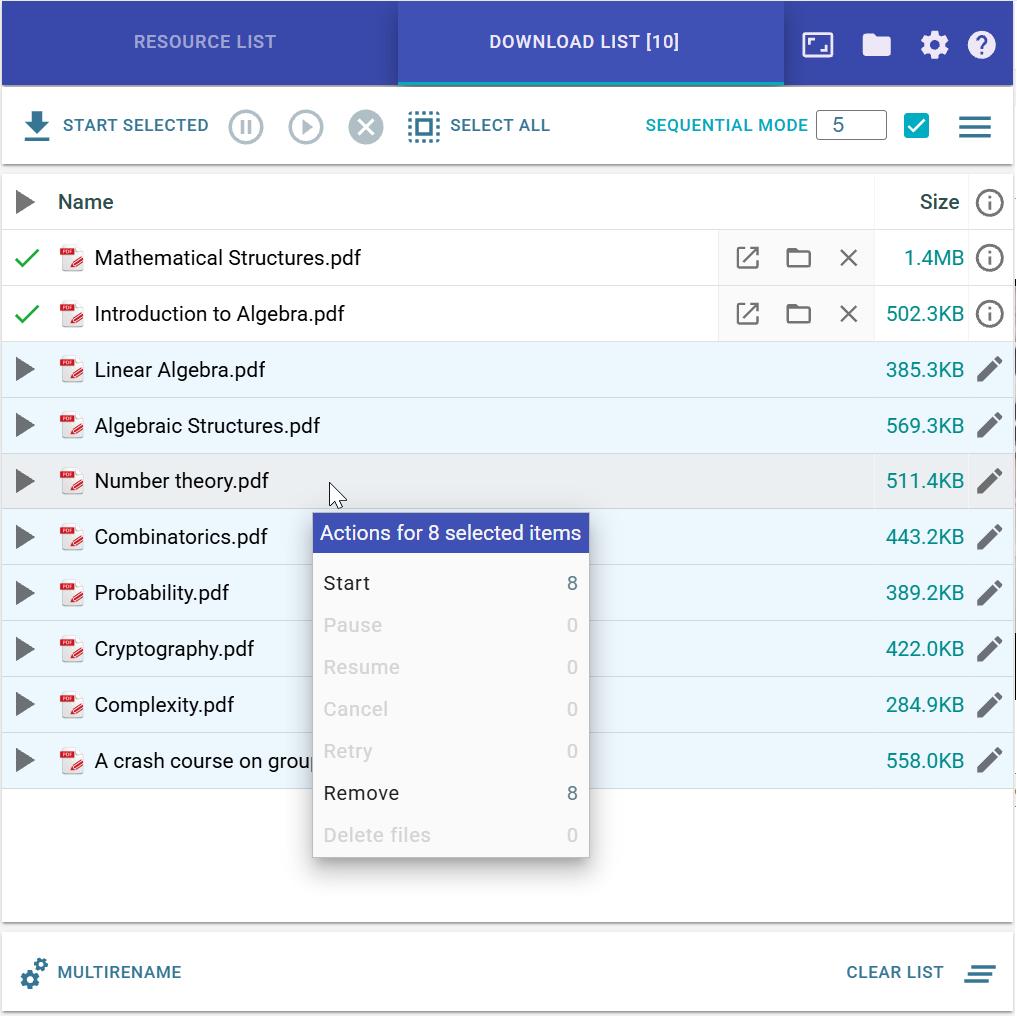
A special note about Sequential mode: this is a global setting. When enabled, queued downloads start one by one, with a customizable interval between them (default: 3 seconds). This reduces pressure on the server and can help prevent stalls.

Some random tips
  1. This quick start is always available from the extension’s help menu. This menu also includes a last-resort Reload extension command.
  2. Those items from the resource list that are also on the download list use a distinctive color for their checkboxes ( or ) and cannot be sent to the download list again unless they are first removed from it. In general, you should not worry about sending the same file multiple times to the download list.
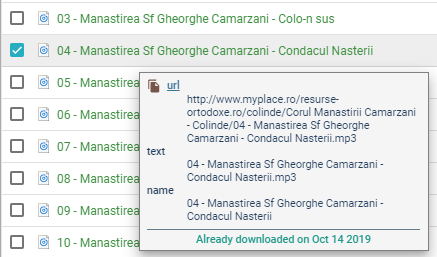
  3. The extension remembers whether items were downloaded in the current session or recent history and displays them in the resource list using green text.
    You can remove these items using the Remove already downloaded command from the hamburger menu.
  4. You can adjust the extension popup width using the button
  5. There are some hotkeys available:
    • Ctrl + V for paste/import from the clipboard (in both the Resource List and Download List panels)
    • Ctrl + A to select all items (in the Download List panel)
    • Ctrl + Up/Down to move selected inactive items (in the Download List panel)
    • Shift + click to select a range of items on both resources and download list
  6. The number of items per page may be set individually for the resource list, thumbnails grid, and download list. For example 200, 50, 50 instead of the default 200 (equivalent to 200, 200, 200)
More advanced usage
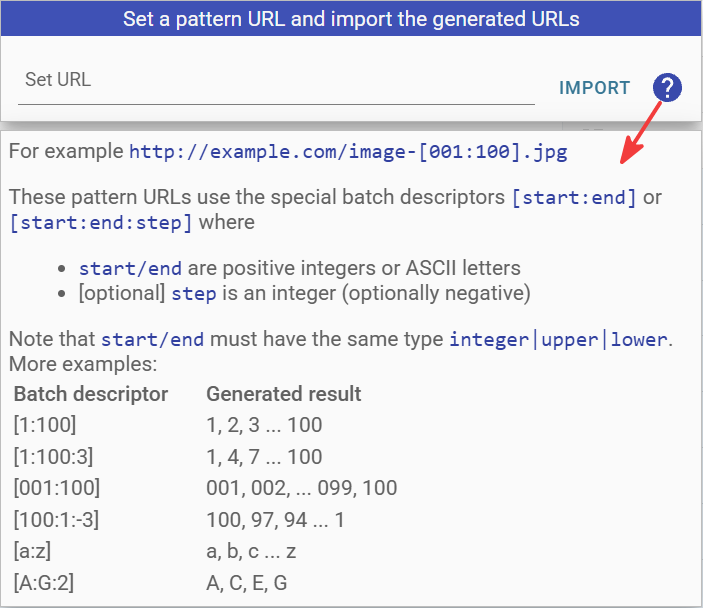
  • Links can be imported from the clipboard or a text file, or generated using a .
    Also, the links can be exported to clipboard or a text file using a (this can be useful if you want to use the generated list with an external file downloader). See the .
  • The extension has a built-in routing system (see the Automatic Folders section in the settings dialog). Here you can define custom folders where downloads can be automatically directed based on user-defined rules. See here for more details.
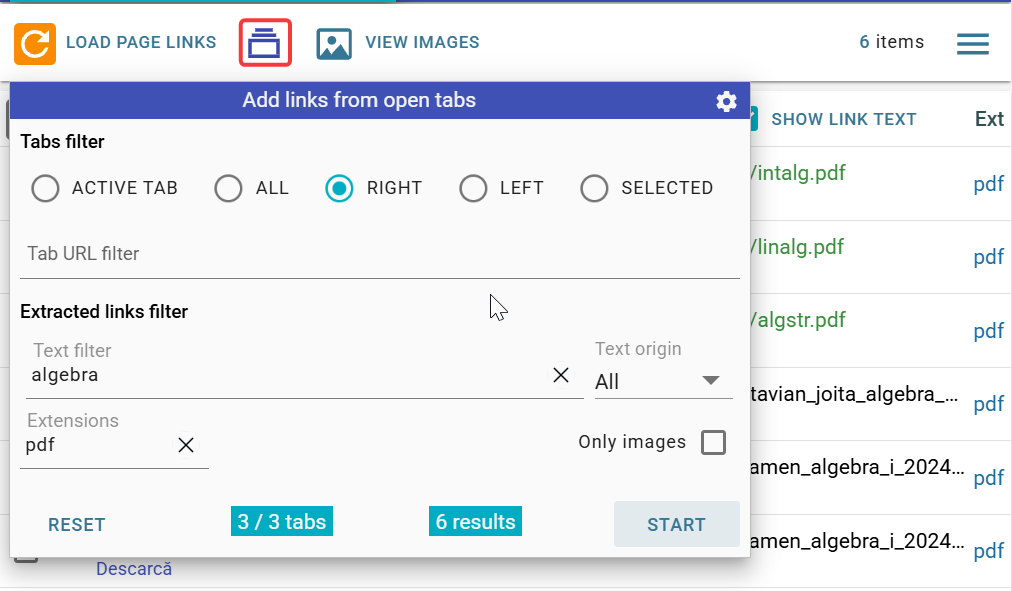
  • The extension has a where you select tabs (active tab, all tabs, left or right tabs) and optionally filters page items by various criteria. Finally, the found links are added to the resource list and are ready for further operations (see the button).
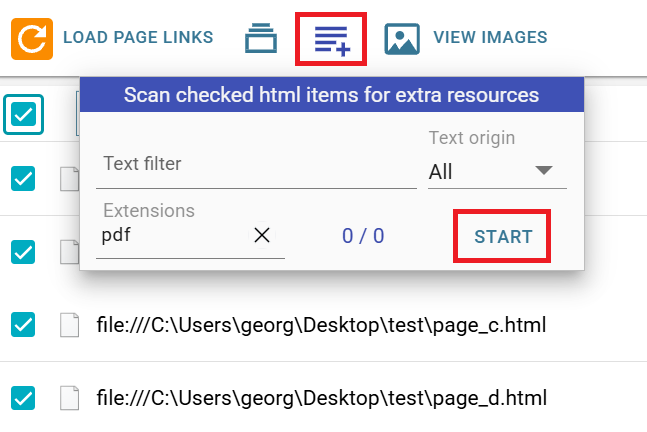
  • There is also an experimental . When available (this must be enabled in general settings), select some web-page resources in the list and the extension will try in the background to extract links from these pages according to the filtering criteria specified in Extra Scan dialog. Finally, the found links are inserted in the resource list below their "parent" item and are ready for further actions. More details here.
Some gotchas
  1. Please verify in your Chrome Download Settings that the following option is NOT checked:

    Otherwise, for every item in the download queue  you will be prompted to choose a file name or directory  via a Save As dialog. Imagine what that means for a list of 500 downloads or more.

    Note: if the settings link does not open directly, copy and paste the following URL into your address bar: chrome://settings/?search=ask+where
  2. Question: Why is the extension unable to download embedded videos?
    Answer: Simple Mass Downloader is designed for normal, direct file links. Embedded videos and streaming media use different delivery mechanisms and are outside its scope. For these resources, use a specialized video or media downloader.
  3. Question: Why is the extension unable to download files from sites X, Y, or Z??
    Answer: The extension detects links exposed by the current page. It scans the page DOM, including accessible open shadow roots, but some sites expose resources in nonstandard ways. In other cases, the visible items are only placeholder links: the real URLs are generated on the fly, only after a user action. Such URLs cannot always be collected in advance.
  1. Click the Extensions button in the toolbar.
  2. Find Simple Mass Downloader in the list.
  3. Click the pin icon next to its name.
Typically, any downloadable resource has attributes like the ones below:
URL visible in the status bar when you hover over the link. The last part of the URL usually provides the default name and extension for the downloaded file. For example https://www.example.com/aaa/bbb/name.pdf
text the visible link text, as it appears on the page
alt the alternative text, usually hidden and associated with images
title additional information that appears when you hover over the link
The extended version provides additional options:
This is an advanced feature and can be skipped at first. These masks can be used in the following contexts: Masks can use several sources: For a quick example, suppose a resource has the URL https://www.example.com/aaa/bbb/some_name.pdf. Then: More specific details are provided in the following sections of this guide.

This shows the available link attributes, including a thumbnail preview for image items.

It also indicates whether the item was downloaded before, including the download date.

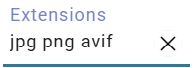
You can indicate one or more extensions separated by spaces (or commas)

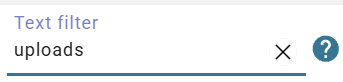
When the text filter field is focused, an inline help button appears. Clicking it opens an explanatory popup:
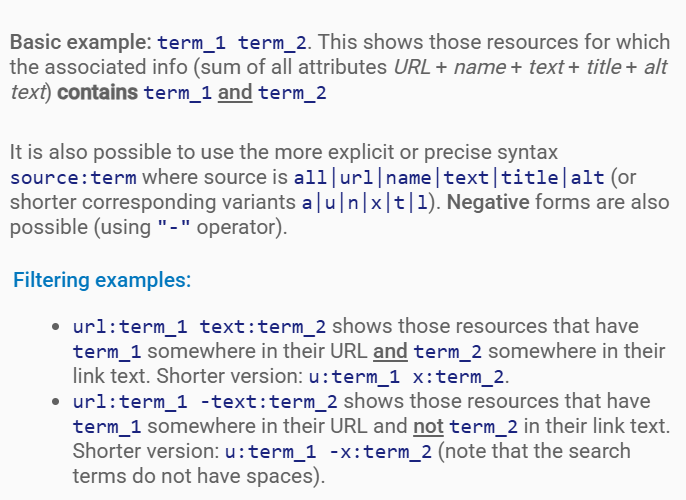
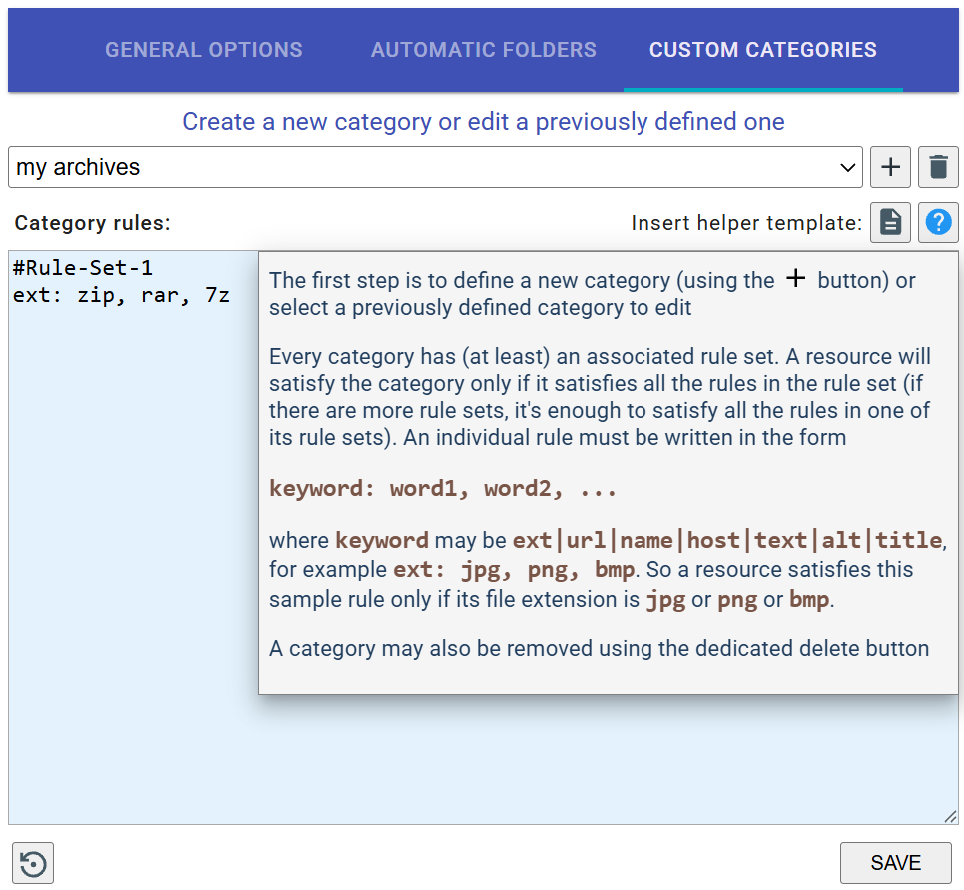
You can create complex filters and save them as custom categories. To do this, go to the extension's general settings using the button, then open the Custom Categories panel.

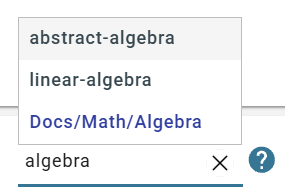
When the directory field is focused, an inline help button appears. Clicking it opens an explanatory popup:
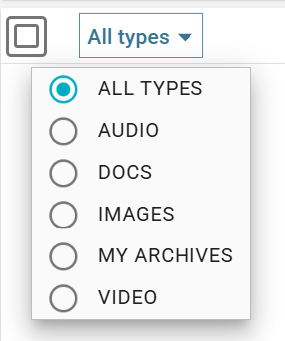
To create favorite folders, go to the extension’s general settings using the button and find the Download directories section.

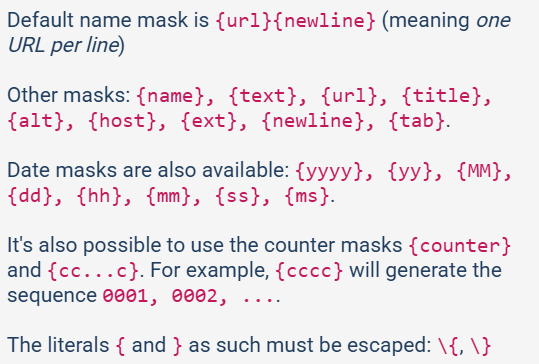
When the name mask field is focused, an inline help button appears. Clicking it opens an explanatory popup:

Comment: The syntax used for batch descriptors broadly follows the one defined by DownThemAll here.

To configure the mask format, go to the extension’s general settings and find the Link export format section.

A click on the help button open the following explanatory dialog
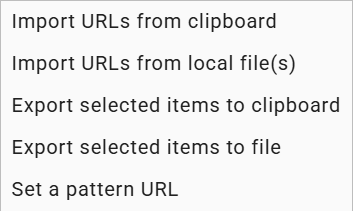
Below is the hamburger menu for the download list, but the import-export functionality is also included in the hamburger menu for the resources list